
Imagine a shop that ordered 500 units of a product last month and only sold 200 of them. The remaining stock just sits there, taking up shelf space and holding up cash that could be put to better use.
This happens a lot, and it usually comes down to one thing: retailers order based on guesswork or old sales patterns, not on how fast products are actually moving.
So how do you catch this early?
That's exactly what sell-through rate tells you. UK online retail sales values grew by 11.7% year on year in early 2026, but a rise in sales doesn't always mean stock is moving well. Some of that growth can still hide products that are stuck on shelves for months.
This guide explains what sell-through rate means, how to calculate it, and how retailers can easily improve it step by step.
What Is Sell-Through Rate?
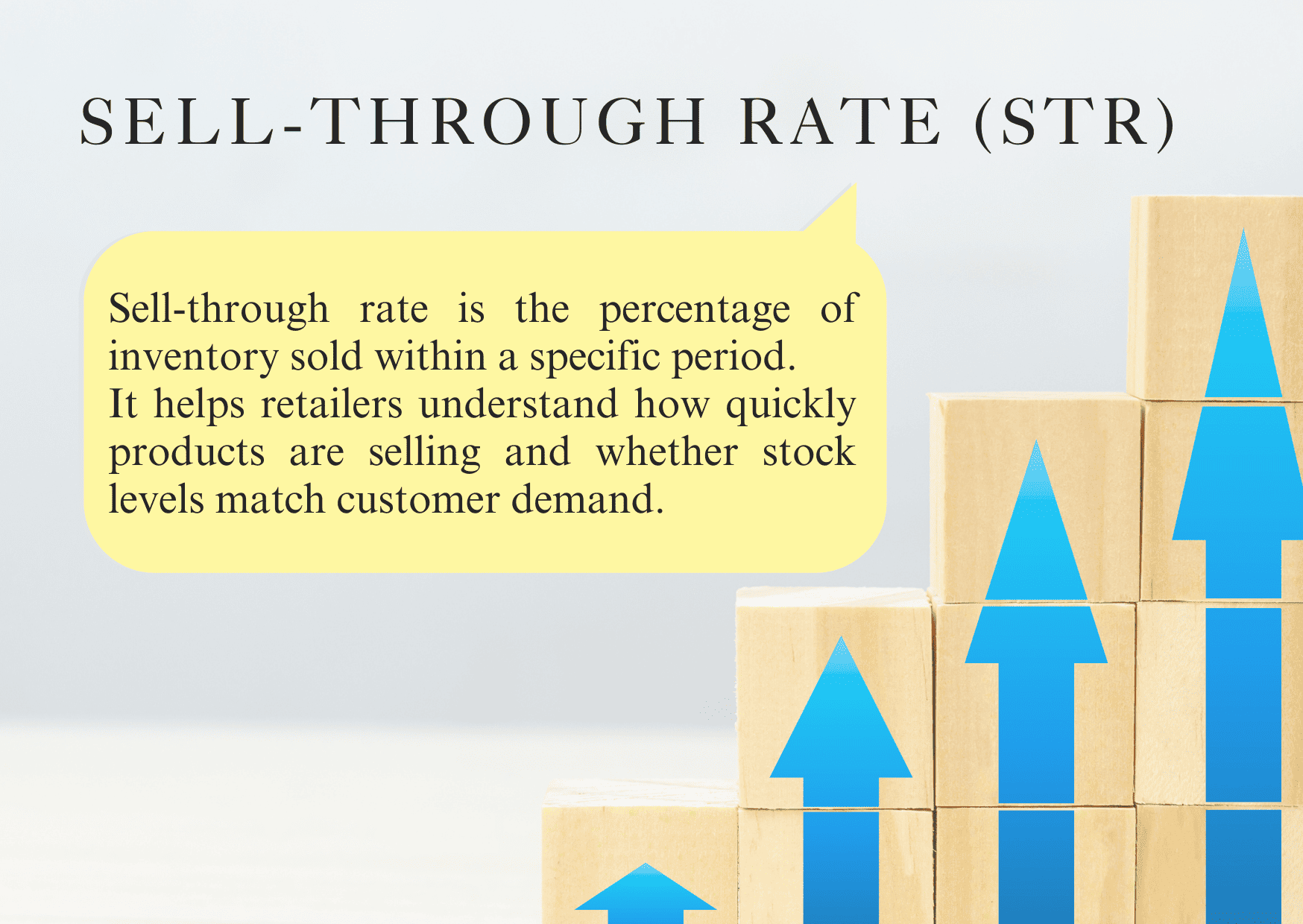
In simple terms, sell-through rate is the percentage of inventory a retailer sells within a specific period compared to the total stock it had available. If you received 100 units of a product and sold 60 of them in a month, your sell-through rate for that product is 60%.
The sell-through rate meaning goes beyond just a number on a spreadsheet, though. It tells you how well your stock matches actual demand. A high sell-through rate usually means your product is selling close to how fast you expected. A low one signals that you probably ordered too much, priced it incorrectly, or misjudged how customers would respond.
Sell-Through Rate and Rate of Sale are Two Different Things
People often confuse sell-through rate with rate of sale, and it's important to clarify the differences.
The rate of sale is the speed at which units sell, often measured in units per day or per week. Sell-through rate, on the other hand, measures the proportion of stock sold within a given period, expressed as a percentage.
So while rate of sale tells you how fast something is moving, sell-through rate tells you how much of your total stock actually moved. Both metrics matter, but they answer slightly different questions.
Sell-Through Rate Formula: How to Calculate It With Example
Sell-Through Rate = (Units Sold ÷ Units Received) x 100
You take the number of units sold, divide it by the number of units available during that same period, then multiply by 100 to get a percentage.
Here's a quick example to clarify. A homeware retailer in Manchester brings in 400 candles at the start of the month and sells 280 of them by month-end. So in this case the calculation works out like this:
(280 ÷ 400) x 100 = 70%
That's a healthy number for most home goods categories. The remaining 30% carries over as leftover stock, and that figure then shapes decisions around reordering, discounting, or bundling.
Getting the correct sell-through rate matters more than most retailers realise, since one widely cited study found that retailers lose $1.1 trillion globally each year from overstocks and out-of-stocks combined. Every unsold unit ties up cash that could go elsewhere, and every stockout on a bestseller means walking away from a sale you should have made.
Common Calculation Mistakes
A few things trip retailers up when they run this calculation, so it helps to know them in advance.
The first is mismatching time periods. If you compare a week of sales against a month of stock received, the resulting number won't mean much, so it's important to keep both sides of the equation within the same window.
The second is using an inconsistent baseline. If you only count opening inventory and ignore stock that arrived mid-period, your "available" figure ends up understated, which makes the rate look better than it actually is.
The third and final mistake is about timing rather than the formula itself. A fashion collection sitting at a 40% sell-through rate one week after launch isn't necessarily a bad sign, since the collection is meant to sell over three or four months anyway. But that same 40% at the end of the season is a real problem, because by then the business should have cleared 80% to 90% of the range.
Weekly, Monthly, or Seasonal Tracking of Sell-Through Rate
Weekly tracking works well for fast movers like groceries or fashion basics. Monthly tracking suits most general retail categories. Seasonal windows matter most for weather-driven products like outerwear or garden furniture, and this is especially true in the UK.
Clothing sales actually fell in spring 2026, with retailers pointing to unpredictable weather, only to rebound the following month when warmer conditions lifted demand for outdoor furniture and fans. That kind of swing shows why judging seasonal stock across its full selling window works far better than judging it off a single month.
What Counts as a Good Sell-Through Rate?
The honest answer is that it depends on your category, but real industry data gives us something solid to work from.
Across general retail, a sell-through rate between 40% and 80% is considered healthy. Below that range, your stock is sitting for too long. Above it, you're probably running close to stockouts, which brings its own set of problems.
Health and beauty deserves closer attention here, because the category has a real overstock issue. Research on retail waste found that beauty products lose more inventory to overproduction than any other category, at 6.2% a year, compared to 3.9% for apparel, 3% for pharmaceuticals, and 2.9% for food.
In one documented case, a major beauty retailer was found to be so overstocked that 20% to 30% of its inventory was either out of season or past its expiry date by the time anyone noticed. That's not a small margin for error. With expiry dates in play, a low sell-through rate in this category doesn't just mean lost profit. It means the stock becomes completely unsellable.
UK retailers across the board are feeling this pressure too. According to the Retail Resilience Barometer research, 62% of UK retailers said overstocking was a genuine concern for their business, and 99% admitted to losing at least £10,000 in revenue every quarter because of unsold stock. Even more striking, retailers reported having to discount nearly half (48%) of their total stock due to overstocking.
So, this isn't a niche problem. It's an industry-wide one, and it directly ties back to how well retailers track their sell-through rate before it's too late.
Why Sell-Through Rate Matters for Retailers
Every unit sitting unsold on a shelf is money you've already spent but haven't recovered yet. Accountants call the gap between buying stock and getting paid for it “the cash conversion cycle.” The longer this cycle runs, the tighter working capital gets, and the less room there is to react to anything else.
Research from Grant Thornton found that UK-headquartered companies had over £125 billion in excess cash tied up in working capital, much of it sitting in inventory that could otherwise fund growth. A separate analysis of the wider SME sector puts the figure even higher, with more than £112 billion locked up because stock and invoices aren't converting to cash fast enough.
Here's what tracking sell-through rate actually gives you:
- An early warning system. A dropping sell-through rate signals that cash is piling up in stock rather than moving through the business, well before it turns into a bigger problem.
- Room to act while options are still open. You can adjust price, run a promotion, or move stock to a faster-selling channel while there's still time, rather than waiting until markdowns are the only option left.
- Protection against expiry risk. In health and beauty specifically, slow sell-through doesn't just mean lost profit. It can mean stock expiring before it ever reaches a customer.
- A clearer view of hidden costs. Every extra week a product sits unsold adds another week of storage costs, whether that's owned warehouse space or a third-party facility charging by pallet. These costs rarely show up as a line item tied to a specific product, which makes them easy to ignore until they add up.
- Better supplier relationships. Retailers who closely track sell-through rates can reorder winning products faster, which builds trust with suppliers and leads to better terms over time. And those who skip this tend to either over-order out of caution or under-order out of fear.
Factors That Affect Sell-Through Rate
Several things push sell-through rate up or down, often at the same time. Here are all the factors that affect the sell-through rate, backed by real data:
Demand forecasting accuracy
This is usually the biggest factor. Research on retail forecasting found that 58% of brands report inventory accuracy below 80%, and only 35% of businesses feel confident in their forecasts at all. McKinsey research on AI-driven forecasting found it can cut supply chain errors by 30% to 50%, reduce lost sales by 65%, and lower warehousing costs by up to 40%. That gap shows how much room most retailers have to close.
Stock availability itself
Sell-through rate isn't only hurt by too much stock. Running out matters just as much. UK research on out-of-stocks found that 27% of UK shoppers would question their loyalty to a retailer if gaps on shelf became a regular occurrence, 21% would abandon their basket entirely, and 27% would switch to a competitor on the spot.
A product that's always unavailable never gets a chance to build a sell-through rate. That’s why it helps to work with wholesale platforms like Qogita, where retailers can access inventory from hundreds of suppliers through a single marketplace.
Product mix and assortment overlap
Carrying too many similar SKUs doesn't just add complexity, it actively splits demand. Launching a new product without clear positioning against existing lines causes an average sales loss of 25% to 30% on the products it overlaps with.
In practice, this means two similar shower gels or supplements competing for the same shelf space can each end up with a weaker sell-through rate than if only one had been stocked.
Pricing relative to the market
Retailers that price without checking what similar products sell for elsewhere are likely to see slower movement, since shoppers (particularly online) compare prices before buying. A price above the market average slows sell-through, even for a product with genuine demand. A low price can trigger the opposite problem: selling out before you've reordered.
Supplier reliability and lead times
Retailers can't always control supplier performance, but they can be selective about who they buy from.
Late deliveries push stock arrival past peak demand windows, particularly for seasonal or trend-driven health and beauty products. When a shipment lands weeks after it was needed, the sell-through rate for that batch takes the hit regardless of how strong demand initially was.
At Qogita, orders typically arrive within 10 business days so you can restock faster and keep popular products available while demand is still there.
Listing quality and product visibility
For online sales, a product that's pretty hard to find in search results or poorly described won't sell through quickly, no matter how good the demand is. This matters even more in categories like beauty and household goods, where shoppers search for specific ingredients or use cases rather than browsing broadly.
Each of these factors interacts with the others, which is why a dip in sell-through rate rarely traces back to just one cause.
How to Improve Sell-Through Rate
Knowing your number is one thing, but improving it is another. Let’s take a look at how you can improve your sell-through rate following these simple steps:
Order smaller quantities, more often.
The instinct to bulk-buy for a better unit price often backfires when demand changes mid-cycle. Buying in smaller, more frequent batches keeps stock closer to actual demand and protects your sell-through rate from sudden dips in a category.
This is exactly where sourcing through a wholesale marketplace like Qogita helps, since it removes the pressure to commit to a large minimum order value from a single supplier.
Time your markdowns using real data, not instinct.
UK retailer Lincolnshire Co-op improved its sell-through rate by 2.6% after adopting a dynamic markdown system that adjusted prices based on demand rather than fixed discount schedules. For a retailer operating on tight margins, that's a meaningful gain.
Separate research on markdown timing found that optimising when and how deep a discount goes can recover two to five percentage points of margin on clearance stock alone, compared to reactive, last-minute discounting.
Get pricing right before you discount.
McKinsey research found that a 1% improvement in pricing accuracy leads to an 8.7% increase in operating profit, which is a bigger lever than most retailers give it credit for. Before reaching for a discount, you must check whether the product is priced in line with what similar items sell for elsewhere. A price even slightly above the market average can quietly stall sell-through long before it appears to be a stock problem.
Reorder your winners while demand is still hot.
A product that sells quickly early on is usually telling you something: customers want it. If you wait too long to reorder, you can end up with empty shelves and missed sales while fresh stock is still on the way.
Many retailers set a reorder point based on sales progress rather than stock levels alone. For example, if a product has sold through half its inventory much faster than expected, it may be time to place the next order before availability becomes a problem.
Use best-selling items to clear slower stock.
In many cases, pairing a slower-selling item with a popular one can help clear dead stock while protecting margins. This approach works pretty well in categories like health and beauty, where customers buy related products together. For example, a combo of cleanser with moisturiser can feel like a natural purchase rather than a promotional bundle.
Track sell-through rate by SKU, not just by category.
A category can appear healthy overall while a handful of products quietly underperform. Looking at sell-through rates for individual SKUs makes it easier to spot these issues early, before slow-moving stock starts affecting the performance of the wider range.
Sell-Through Rate vs Other Inventory Metrics
Sell-through rate is useful, but it doesn't work alone. Here's how it compares to the other related metrics retailers commonly track:
Used together, all four metrics cover speed, volume, efficiency, and profit. But relying only on a single one will leave a blind spot somewhere, and that's usually the one that ends up costing the most.
Conclusion
At the end of the day, your sell-through rate tells you what's actually selling and what's just gathering dust on the shelf. It's the number that shows where your cash is stuck, month after month. You must check it regularly and measure it against your own selling window, not someone else's benchmark.
Sourcing plays a big role in getting this right in the first place. On Qogita, retailers can buy verified wholesale products without committing to huge minimum orders. That means you can try out new products, see what your customers actually want, and reorder your bestsellers before they run out.
Sell-Through Rate FAQs
What is sell-through rate?
Sell-through rate is the percentage of stock a retailer sells within a set period, compared to what it had available. It shows how well inventory matches actual demand.
What is the sell-through rate formula?
Sell-Through Rate = (Units Sold ÷ Units Received) x 100. You calculate it for any product, category, or time period you choose.
What is a good sell-through rate on eBay?
Most eBay guides consider 70% or higher strong, 40% to 70% healthy, and under 20% a sign to avoid that product entirely.
What does Amazon sell-through rate mean?
Amazon calculates FBA sell-through rate as units shipped over 90 days divided by average inventory held, and uses it to help set your storage limits and IPI score.
What does 100% sell-through mean?
It means every single unit you received sold out within the period you measured, leaving no leftover stock at all.