
Have you ever added an extra item to your online shopping cart just to get free shipping? If so, you already understand the basic idea behind a minimum order quantity or a minimum order value.
While a local shop is happy to sell you a single loaf of bread, manufacturers and wholesalers operate differently. They need to ensure that every shipment they send out covers their costs and makes a profit.
Because of this, they set specific limits on how much you must buy. Understanding these terms is a key part of running a successful retail business and managing your inventory.
In this guide, we will explain everything you need to know about minimum order quantity, including its meaning, benefits, how to calculate it, negotiation tips, and more.
What is Minimum Order Quantity (MOQ)?
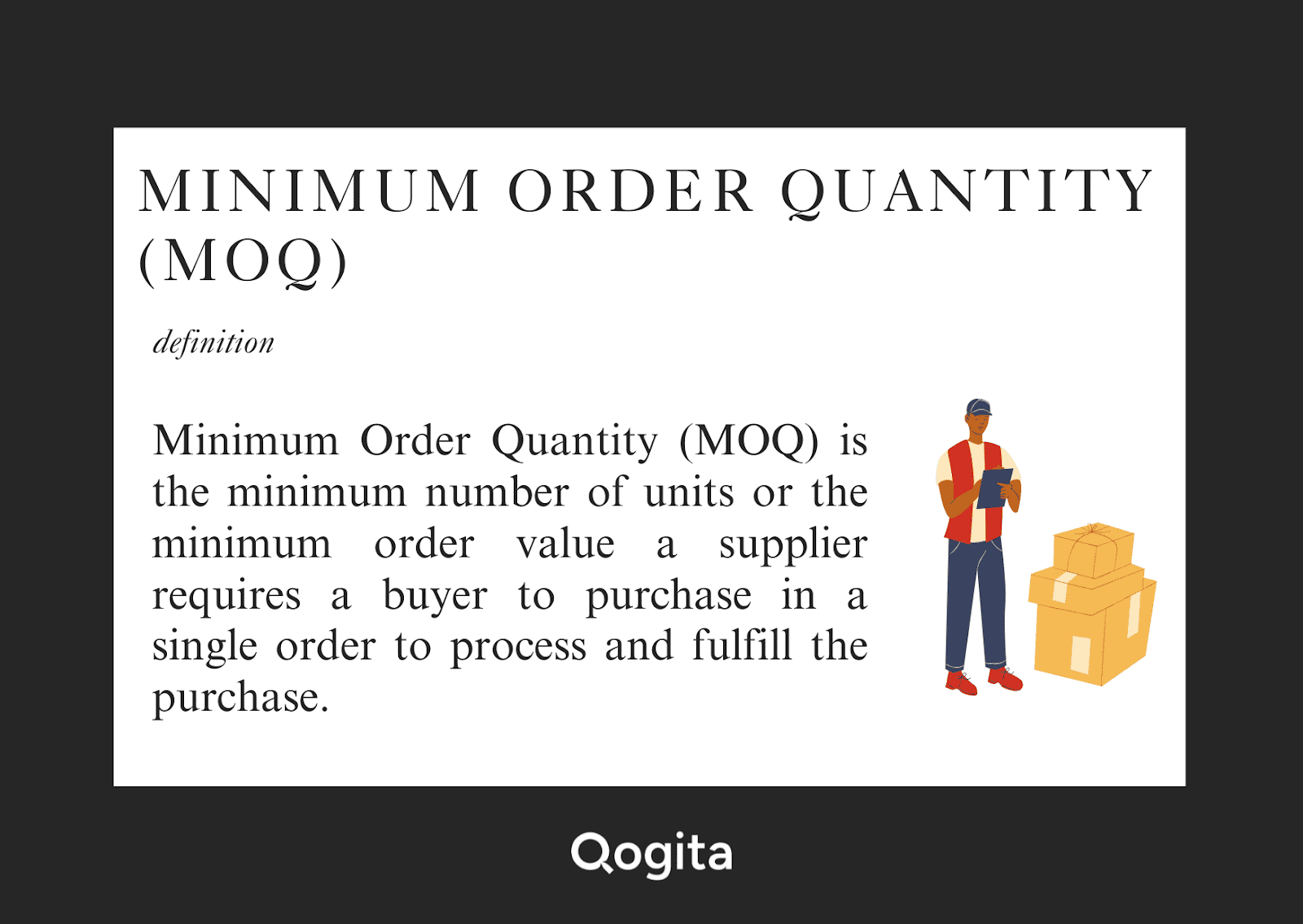
A minimum order quantity is the smallest number of units a business allows you to buy in a single order. Suppliers use this to make sure that the time and money they spend on an order actually result in a profit.
For example, a company that makes custom water bottles might have an MOQ of 100 units. This means they will not accept an order for 10 or 20 bottles because the cost to set up the machines and print the logos would be higher than the money they make from such a small sale.
MOQ Definition
In the simplest terms, the MOQ is the minimum quantity you must purchase to complete a transaction. It is a standard rule in the wholesale world. If a buyer cannot meet this number, the supplier will usually decline the order or refer the buyer to a smaller distributor who handles smaller volumes.
What is Minimum Order Value (MOV)?
You might have noticed that some suppliers use a slightly different term instead of MOQ: MOV.
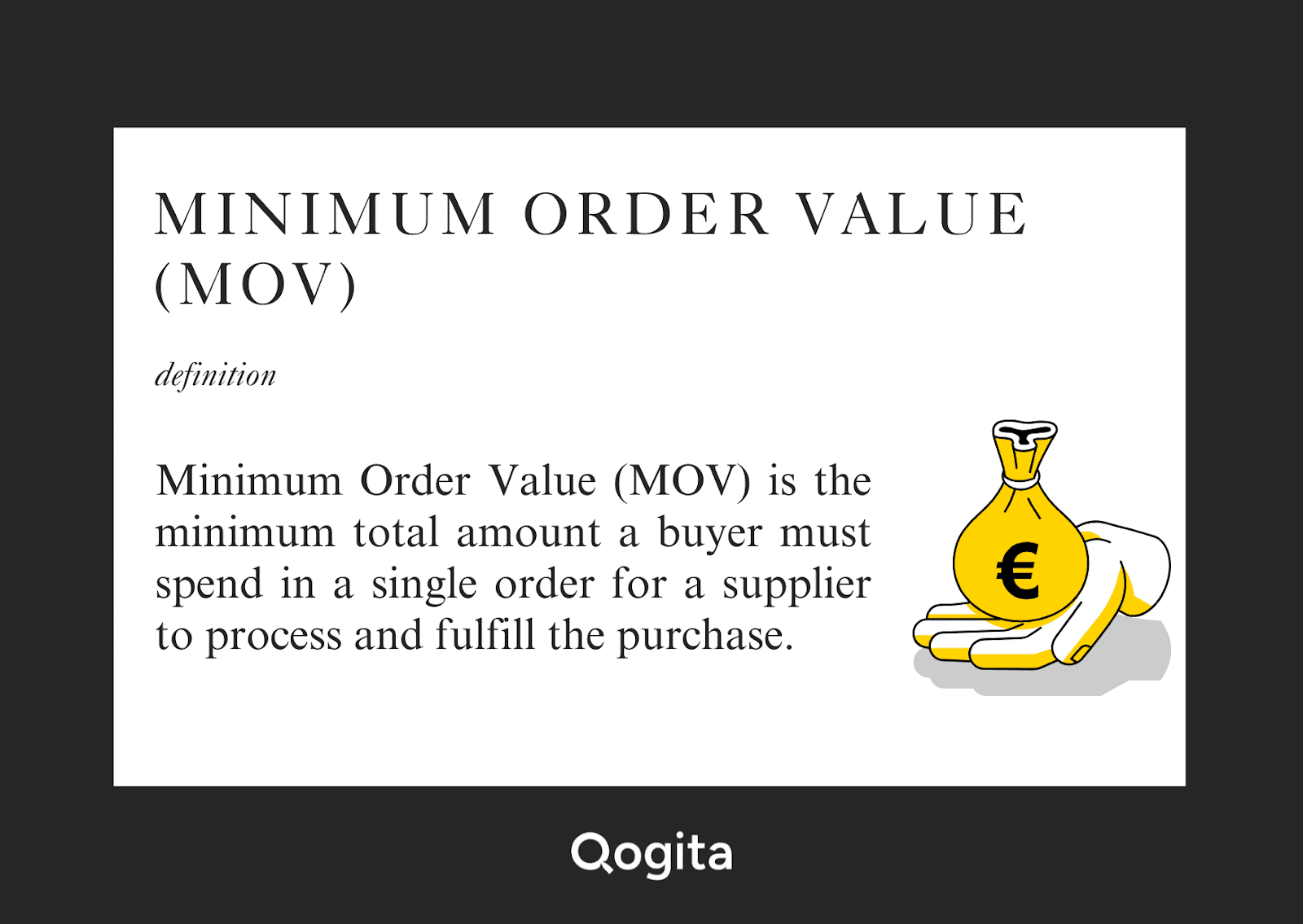
Minimum order value, or MOV, is the lowest amount a customer must spend to place an order. Instead of telling you that you must buy 50 shirts, a supplier might tell you that your total order must be at least $500.
This limit helps suppliers cover the administrative costs of a sale, such as billing, accounting, and shipping logistics. If you are wondering what is mov in a practical sense, it is often used when a wholesaler carries many different types of products. They might not care if you buy ten of one thing or twenty of another, as long as the total value of your cart reaches their required minimum.
Why Do Suppliers Use Minimum Order Quantity?
Suppliers use a minimum order quantity primarily to protect their profit margins. It costs a lot of money to run a warehouse or a factory. There are fixed costs, such as electricity, labor, and machine maintenance, that remain the same whether a supplier sells one item or one thousand. By setting an MOQ, they ensure that every order covers these overhead costs and leaves some room for profit.
Another reason for these limits is efficiency. It is much faster and cheaper for a supplier to pick, pack, and ship a single large box than to handle dozens of small packages.
Large orders allow them to take advantage of economies of scale, which means the cost of producing each individual item goes down as the volume goes up. This approach keeps the business stable and lets suppliers offer better pricing to their long-term partners.
High MOQ vs. Low MOQ: Which is Better?
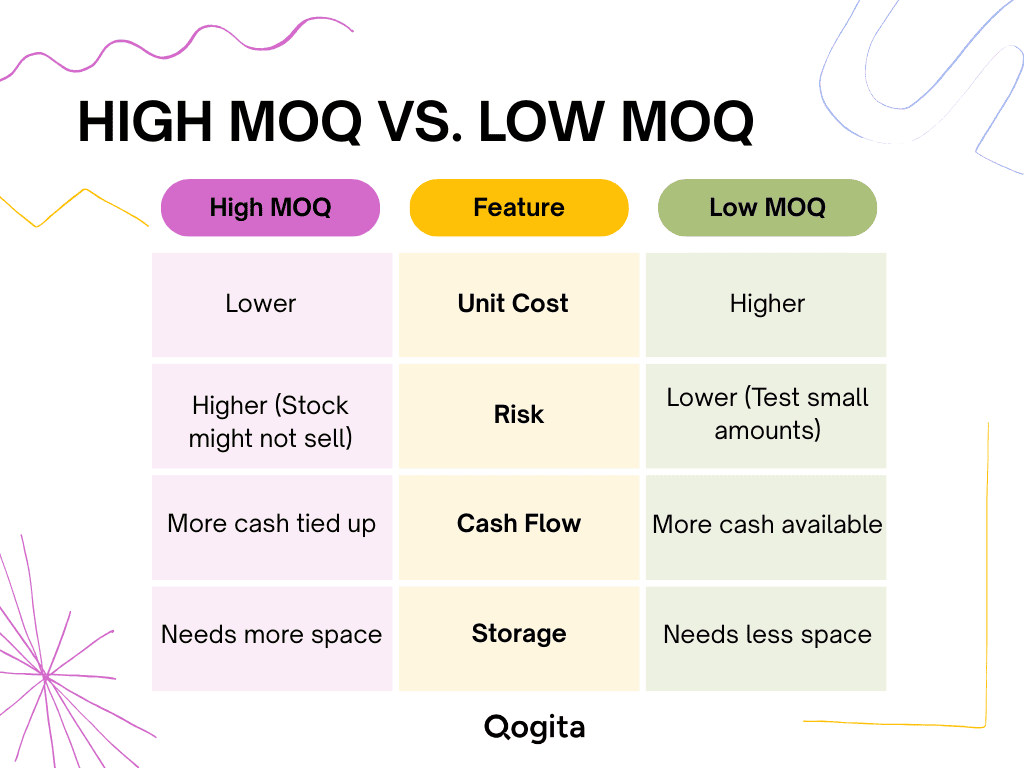
There is no single answer for which type of minimum order quantity is better. It usually depends on your budget, your storage space, and how quickly you can sell your products.
High MOQ: Benefits and Drawbacks
Suppliers usually set a high MOQ for items that are inexpensive to make but require a lot of effort to set up for production.
- Benefits: The biggest advantage is the cost savings. Buying in bulk usually secures the lowest possible price per unit. It also means you spend less time placing orders and managing shipments throughout the year.
- Drawbacks: The main risk is that a large portion of your cash is tied up in stock. If the product doesn't sell as fast as you expected, you might be stuck with dead stock, taking up valuable warehouse space.
Low MOQ: Benefits and Drawbacks
A low MOQ is often offered by distributors or manufacturers who specialize in small batches or high-end goods.
- Benefits: This is perfect for testing new products without a huge financial commitment. It keeps your business agile and reduces the risk of having outdated inventory. It also requires much less storage space.
- Drawbacks: You will almost always pay a higher price for each item. Additionally, because you are ordering smaller amounts, you run a higher risk of running out of stock during a busy week, and your shipping costs per item will likely be higher.
The Different Types of MOQs
Depending on how a supplier operates, you might run into different structures of MOQs. Understanding these helps you identify which suppliers fit your current budget.
Simple MOQs
This is the most common type you will find. A simple minimum order quantity means there is only one lower limit you must meet. This is usually either a specific number of units (e.g., 500 shirts) or a specific amount (e.g., a minimum order value of $1,000). As long as you hit that one requirement, the supplier will process your order.
Complex MOQs
Large manufacturers or wholesalers often use complex MOQs. These involve multiple requirements that must all be met at the same time. For example, a clothing manufacturer might require:
- A minimum of 1,000 total pieces per order.
- A minimum of 250 pieces per color.
- A minimum of 100 pieces per size.
In this case, you cannot just buy 1,000 small blue shirts; you have to balance your order across their specific rules.
Supplier-Set vs. Brand-Set MOQs
Most of the time, we talk about supplier-set MOQs, which are rules the factory gives to you. However, as your business grows, you might implement brand-set MOQs. If you begin selling your products to other retail shops, you might set your own minimums to ensure that your wholesale partnerships stay profitable for you.
How Suppliers Calculate the Minimum Order Quantity
Suppliers do not just pick a number out of thin air when setting their requirements. They use a specific process to strike a balance between competitiveness and profitability. Here is how they typically determine their minimum order quantity:
- Predicting Demand: Suppliers use historical data and market trends to estimate how many units of a product are likely to sell. If a product is very popular, they might set a higher minimum because they know the stock will move quickly.
- Calculating Holding Costs: Storing inventory is expensive. Suppliers have to pay for warehouse space, insurance, and utilities, such as climate control. If an item takes up a lot of room or stays on the shelf too long, the supplier will set an MOQ that ensures the inventory turns over fast enough to keep these costs down.
- Finding the Break-Even Point: This is the most critical step. A supplier adds up all the costs involved in a sale, including raw materials, factory labor, machine setup, and administrative work. They then calculate exactly how many units they must sell in one go to cover those expenses. Anything above this number is where they finally start to see a profit.
The MOQ Formula
While every business is slightly different, the standard way to determine the minimum is by identifying the point where the cost of the order meets the required profit. The basic formula is:
MOQ = (Total Production Cost + Desired Profit) ÷ Unit Price
To get this right, a supplier must account for:
- Fixed Costs: Machine setup, labor, and administrative processing.
- Variable Costs: Raw materials and packaging for that specific order.
- Holding Costs: The expense of storing the items until they are shipped.
Minimum Order Quantity Example
Imagine a factory that produces custom notebooks.
- Fixed Costs: It costs $500 just to set up the printing plates and hire the staff for a single run.
- Variable Costs: Each notebook costs $2 in paper and ink.
- The Goal: The supplier wants to make at least $300 profit on every order to stay in business.
- The Selling Price: They sell each notebook for $10.
If the supplier only sold 50 notebooks, they would collect $500. However, their costs would be $600 ($500 setup + $100 materials). They would lose $100.
To find the minimum order quantity that meets their $300 profit goal, they use the formula:
($500 + $100 materials for 50 units + $300) ÷ $10 = 90 units
In this scenario, the supplier would likely set their MOQ at 100 units to ensure a safe profit margin and cover any unexpected waste.
MOQ vs. EOQ: Knowing the Difference
While these two terms sound similar, they serve very different purposes in your business. One is a requirement you must follow, while the other is a goal you should aim for to save money.
- MOQ (Minimum Order Quantity): This is the rule set by your supplier. It is the absolute smallest amount they are willing to sell to you. It is based on their costs and their need to stay profitable.
- EOQ (Economic Order Quantity): This is a calculation you do for your own business. It is the ideal number of items you should order to minimize your total inventory costs.
To find your EOQ, you look at how fast you sell a product and how much it costs you to store it. The goal is to find the "sweet spot" where you aren't ordering so much that you waste money on warehouse space, but you aren't ordering so little that you constantly run out of stock.
When your EOQ is higher than a supplier's MOQ, you are in a great position. If it is lower, you may need to look at the negotiation strategies in the next section.
4 Negotiation Tips for Handling Supplier MOQs
If a supplier’s requirement is too high for your current budget, you don't always have to walk away. In many cases, these numbers are a starting point for a conversation. Here are a few ways to approach a negotiation:
- Offer a Higher Per-Unit Price: Suppliers set minimums to cover their setup costs. If you are willing to pay a few cents more per item, the supplier might agree to a smaller order because they are still hitting their profit goal.
- Ask for Staggered Deliveries: You can agree to buy the full amount required, but ask the supplier to ship it in smaller batches over several months. This helps you manage your warehouse space and cash flow while the supplier gets the security of a large contract.
- Use Standardized Components: Ask the supplier if they can use materials they already have in stock for other clients. If they don't have to buy special raw materials just for you, they are often more flexible with the order size.
- Inquire About Overruns: Sometimes a factory produces extra items for a large client that were never picked up. Since the setup costs are already paid for, they might sell you these leftovers at a lower price.
Solutions for Small Retailers Dealing with High Minimum Order Quantity
For many small retail businesses, high requirements can be a major roadblock to growth. If you are struggling to meet a supplier's minimum order quantity or minimum order value, you may need to look at alternative ways to source your inventory.
Form a Purchasing Group
You can partner with other small business owners to pool your orders together. By acting as one large buyer, you can meet the high limits of a manufacturer that you wouldn't be able to reach on your own.
Retailers can find potential partners through seller communities on platforms such as Facebook groups, LinkedIn communities, or marketplace-seller forums (for example, Amazon seller groups).
Find Small-Batch Specialists
Not every factory focuses on mass production. Many suppliers specifically target startups and boutique shops by offering very low minimums. While the price per item might be slightly higher, the reduced risk to your cash flow is often worth it.
Look for Smarter Sourcing Platforms
When the minimum order value is the main problem, you should look for wholesale platforms that are designed for retailers rather than giant corporations.
For example, platforms like Qogita help retailers source high-quality products without the stress of massive spend requirements. Because they have a very low MOV, you can buy exactly what you need to keep your shelves stocked without overextending your budget.
Conclusion
A minimum order quantity is a common rule that helps suppliers stay profitable and efficient. It confirms every shipment covers the costs of labor and materials. While high MOQs can be a challenge for small shops, they also offer a way to get better pricing through bulk buying.
By using the above-mentioned negotiation tips and choosing the right sourcing partners like Qogita, you can balance your stock levels and keep your cash flow healthy. Understanding basic terms like MOQ, MOV, EOQ, etc, is the first step toward building a more stable and successful retail business.
Minimum Order Quantity FAQs
What does MOQ mean?
It stands for minimum order quantity, which is the lowest number of units a supplier will sell in one order. It acts as a baseline to ensure the seller doesn't lose money on a transaction.
What does MOQ mean in business?
In a business context, it is a tool used to manage profit margins and overhead costs. It helps companies decide which customers are a good fit for their wholesale or manufacturing model.
What is the MOQ meaning in supply chain?
Within the supply chain, these limits help maintain a steady flow of goods and predictable production schedules. They allow every link in the chain to operate at maximum efficiency.
What does MoQ mean in manufacturing?
In manufacturing, it refers to the volume needed to cover the costs of raw materials and machine setups. It prevents factories from running expensive equipment for just a few items.
What does FOB and MOQ mean?
MOQ is the smallest amount you can buy, while FOB stands for "Free on Board." FOB determines the point where the buyer takes ownership of the goods and becomes responsible for shipping costs.
What is OEM and MOQ?
OEM stands for Original Equipment Manufacturer, which is a company that makes products based on your specific designs. These projects usually have higher minimums because of the custom work required.