
Mini beauty products are having a big moment right now.
Walk into any Sephora or Ulta store today, and you'll notice entire sections dedicated to tiny versions of bestselling products. Scroll through TikTok and Instagram, and you will find "mini hauls" everywhere. Open Amazon, and travel-size listings are moving thousands of units a month.
This isn't a passing trend. The global market for travel cosmetic minis was valued at $6.8 billion in 2025 and is expected to reach $12.4 billion by 2034. In the US alone, mini makeup sales crossed $700 million, up 13% in a single year. On TikTok, fragrance minis surged 205%. On Google, searches were up 76%.
So what's actually driving this? A mix of things: inflation pushing shoppers toward lower-commitment purchases, the TSA 100ml rule making minis a travel necessity, Gen Z's preference for trying before buying, and the fact that a cute tiny product simply performs well on social media.
Mini beauty products are no longer just samples or travel fillers. They have become a category of their own, with dedicated retail sections, brand-exclusive drops, and a loyal consumer base that spans Gen Z to millennials across the US, Europe, and Asia.
This article breaks down why mini beauty products are growing so fast, what the data and experts say, and how retailers and brands are responding to the demand.
Why Consumers Are Buying Mini Beauty Products
#1. Minis Let You Try Without the Risk
The biggest reason people buy mini beauty products is simple: they want to try something without spending full price on it.
This is especially true for skincare and fragrance, where a product that works for one person may not work for another. A full-size serum can cost $60 to $80. A mini version of the same product lets shoppers test it for real without the financial risk.
The numbers back this up. According to Vanessa Kuykendall, Chief Engagement Officer at Market Defense, 40% of fragrance shoppers who buy a mini say they plan to purchase the full size afterward. That's not just trial behavior, that's a purchase pipeline.
You can see the same pattern on K-beauty platforms. On Zigzag, a fashion and beauty platform run by KakaoStyle, searches for "mini blush" jumped 1,582% and "mini perfume" rose 1,030% year over year. On Ably Corporation, another Korean fashion and beauty platform, one of Hince's 2ml mini tint products saw a 1,692% increase in transaction volume in a single quarter.
As Byrdie, a beauty-focused platform, explains, mini beauty products are increasingly being used as strategic sampling tools, helping shoppers reduce purchase hesitation while giving brands direct feedback on new formulas.
For brands, this is a win too. A shopper who finishes a mini and loves it is far more likely to come back for the full size than someone who never tried the product at all.
#2. Mini Beauty Products Are Simply More Affordable
Beyond trial, there's a clear financial reason why mini beauty products are growing: they cost less, and right now, that matters.
With inflation squeezing disposable incomes, shoppers, particularly younger ones, are being more conscious about where they spend. Mini beauty products give them a way to still buy premium brands without stretching their budget. Instead of committing to one expensive full-size product, a shopper can pick up two or three minis for the same price.
This dynamic is playing out clearly in the K-beauty market. Banila, for example, reduced its 30ml foundation, which retails for 34,000 won, down to a 14ml version priced at 16,000 won. Lilybyred followed a similar approach, cutting its lip tint from 6 grams to 2.5 grams and dropping the price from 14,000 won to around 8,000 won. The product and quality are the same but they launched minis at a price point that feels more affordable.
Professor Kim Joo-deok of Sungshin Women's University explains it this way: "Young consumers are quick to follow trends and tend to seek rational spending choices amid economic uncertainty. Buying a variety of smaller, more affordable products for a broader experience has become a defining trend."
Simply put, mini beauty products let shoppers feel like they're getting more for less.
#3. Travel Made Mini Beauty Products a Necessity
Affordability and trial culture explain a lot of the demand, but there's another factor that has been quietly driving mini beauty product sales for years: travel.
Anyone who has stood in an airport security line knows the frustration of the TSA 100ml liquid rule. That single regulation has, almost by design, created a permanent market for mini beauty products. You either buy minis or you check a bag. For frequent travelers, the choice is pretty obvious.
And travel is booming. In 2025, global air passenger numbers surpassed 4.7 billion annually, and that figure is expected to exceed 6 billion by 2034. More travelers means more people looking for TSA-compliant skincare, haircare, and makeup, which directly feeds mini beauty product demand at airports, online, and in retail stores.
Clare Varga, head of beauty at trend forecasting agency WGSN, connects this clearly: "The rise of wellness tourism and in-flight beauty regimes has increased demand for travel and security-friendly products." She also points out that minis fit well into the smaller, more functional living spaces that younger consumers tend to occupy, making them practical beyond just travel.
The travel retail channel reflects all of this. In 2025, it accounted for 23.8% of total mini beauty product distribution, with major airport hubs like Heathrow, Amsterdam Schiphol, and Frankfurt International serving as important retail venues for the category.
L'Oreal reported that its travel retail channel grew at more than twice the rate of its overall business in 2025, which says a lot about where consumer demand is heading.
#4. Social Media Turned Mini Beauty Products Into a Cultural Moment
Travel and affordability created the demand. Social media poured fuel on it.
Mini beauty products are, by nature, visually appealing. They're cute, compact, and highly photographable. On platforms like TikTok and Instagram, where attention is won within the first 1-3 seconds of a scroll, a miniature product stops thumbs in a way a regular-sized bottle simply can't.
The numbers reflect this clearly. Fragrance minis alone surged 205% on TikTok and 76% on Google. Searches for "mini shadow" on Ably rose 440% in just a 19-day window compared to the same period the previous year. Clare Varga of WGSN points to what she calls the "fun factor" as a serious driver here. "You simply can't underestimate the consumer appeal of anything made miniature," she said. And that appeal doesn't just live online.
Editorial outlets like Vogue, Allure, and Glamour have all started featuring mini beauty products in their best-of lists and editors' picks, which gives the format a layer of credibility that goes beyond social buzz.
The Mini Beauty Products Global Market: What the Data Says
The reasons people love mini beauty products are clear. But how big is this market actually getting? Turns out, it’s getting very big. The data below clearly shows that mini beauty products are no longer a side category but a serious and fast-growing part of the global beauty industry. Let's look at the numbers.
1. What’s the Global Market Size?
The global travel cosmetic minis market was worth $6.8 billion in 2025 and is expected to reach $12.4 billion by 2034, growing at a CAGR of 6.9%. That's nearly double in under a decade.
A big part of this growth is tied to the travel rebound. Global air passengers crossed 4.7 billion in 2025 and are forecast to exceed 6 billion by 2034. More travelers naturally means more people reaching for compact, carry-on friendly beauty products.
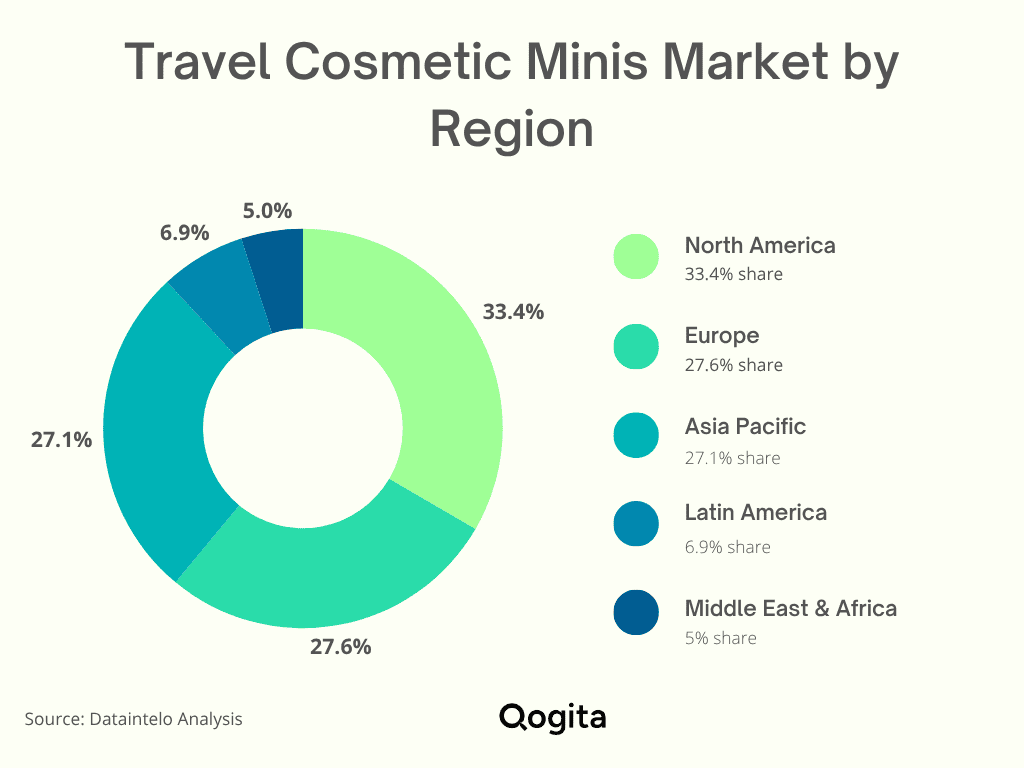
Regionally, North America and Europe hold the largest share while Asia Pacific is the fastest-growing market, expanding at a CAGR of 8.4%, led by China, South Korea, and India.
2. Which Mini Beauty Products Are Selling the Most?
Not all mini beauty products are growing at the same pace. Some categories are bigger, and some are moving faster than others.
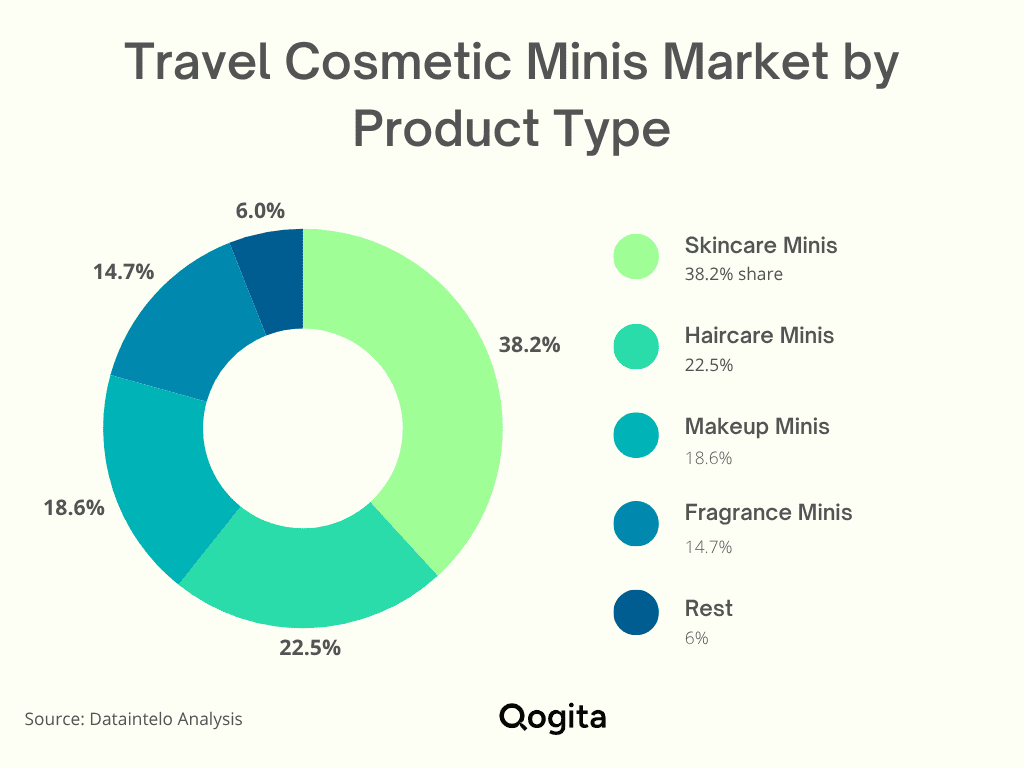
Skincare minis are currently the largest segment, accounting for 38.2% of the market in 2025, translating to roughly $2.6 billion in global revenue.
This makes sense when you think about it. Skincare routines (thanks to trends like “Glass Skin”) have become more involved over the years, and travelers are no longer willing to skip their serums, moisturizers, and SPF just because they're on the road.
Brands like Kiehl's, Estée Lauder, and La Roche-Posay have invested heavily in travel-size versions of their hero products, making it easier for consumers to stick to their routines while traveling.
Haircare minis come in second at 22.5% of the market, followed by makeup minis at 18.6%. Fragrance minis, while currently the smallest of the main categories at 14.7%, are actually the fastest-growing segment of all, with a projected CAGR of 8.1% through 2034. Luxury brands are using fragrance minis to introduce new customers to their products at an affordable price point, and the gifting appeal of a compact perfume bottle is hard to beat.
Here's a quick view of how the market breaks down by product type:
- Skincare minis: 38.2% share
- Haircare minis: 22.5%
- Makeup minis: 18.6%
- Fragrance minis: 14.7% (fastest growing at 8.1% CAGR)
3. Where People Are Buying Mini Beauty Products?
Knowing what's selling is one thing. Knowing where people are buying it is just as important, especially for brands and retailers trying to find the right customers.
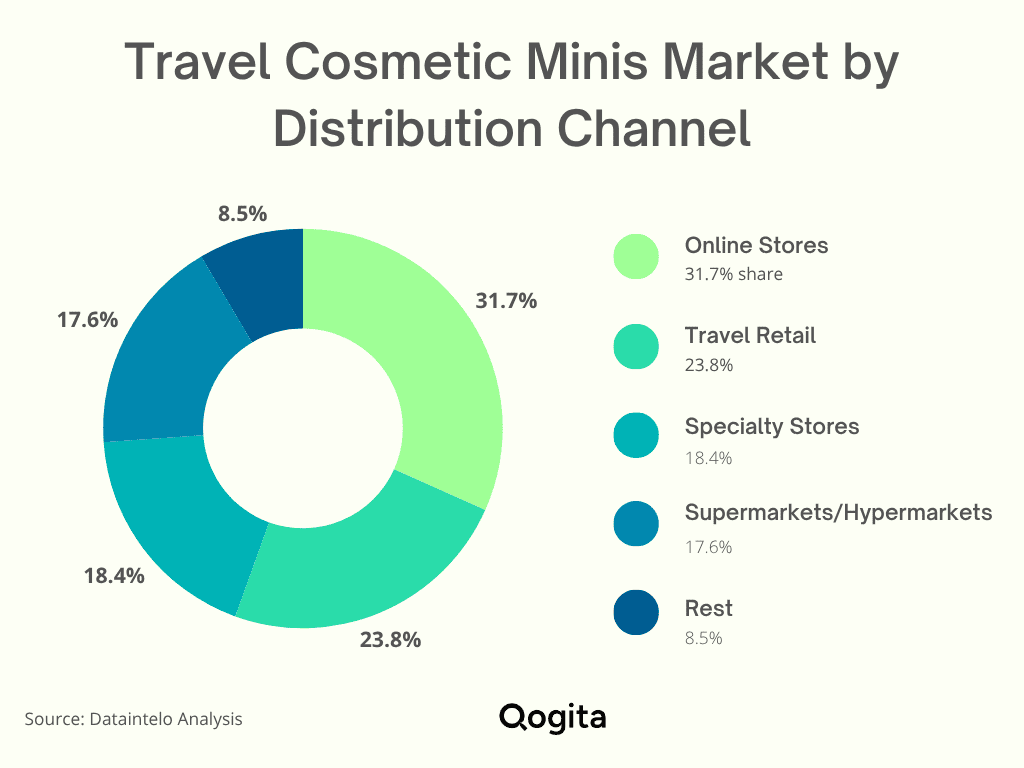
Online stores are the biggest channel for mini beauty products, accounting for 31.7% share of the market. More importantly, they are also the fastest-growing channel, expanding at a CAGR of 9.2%. Subscription beauty boxes, brand websites, and mobile shopping have all made it incredibly easy for consumers to find and buy minis.
Travel retail, which means airport duty-free shops and terminal stores, comes in second at 23.8%. This channel has a unique advantage: it catches shoppers at the exact moment they are most likely to need a mini beauty product. A traveler standing in an airport terminal is already thinking about what they need for their trip, making it one of the highest-converting environments for this category.
Specialty beauty stores like Sephora and Ulta account for 18.4% of the market. These stores play an important role for premium and prestige mini launches. Knowledgeable staff, curated displays, and a beauty-focused shopping environment make these stores ideal for introducing consumers to new mini beauty products.
Mini Beauty Products in Europe: A Market Worth Watching
After North America, Europe is one of the most important markets for mini beauty products. The region has a unique mix of factors working in its favor: a strong travel culture, a well-developed retail infrastructure, and consumers who care deeply about quality and sustainability.
1. How Big Is the European Market
Europe accounts for 27.6% of global travel cosmetic minis revenue in 2025, making it the second largest regional market after North America. The region is expected to grow at a CAGR of 6.2% through 2034. This growth is driven by some very specific local factors.
The most obvious one is travel. Europe has one of the densest air travel networks in the world, thanks to the EU's Open Skies policy, which has made short and medium-haul flights a routine part of everyday life for many Europeans.
Airports like Amsterdam Schiphol, Frankfurt International, and Heathrow have become major beauty retail destinations in their own right. They offer travel retail setups that give mini beauty products maximum visibility.
Key markets within Europe include the UK, Germany, France, and the Netherlands.
2. Sustainability Is Shaping the European Mini Beauty Market
One thing that sets Europe apart from other regions is how seriously consumers and regulators take sustainability. And in the mini beauty products space, this is becoming a defining factor.
The core concern is packaging waste. It is estimated that around 100 million miniatures are purchased every year in the UK alone, generating roughly 980 tonnes of plastic waste. The problem is that most of this plastic never gets recycled. As Claudia Gwinnutt, founder of reusable mini beauty company Circla, explains: "Recycling facilities have equipment that removes small pieces of plastic and diverts it to landfill where it takes hundreds if not thousands of years to biodegrade."
This is pushing both brands and regulators to act. The EU's Packaging and Packaging Waste Regulation is already pushing brands to invest in more eco-friendly mini packaging. As a result, we are starting to see more refillable formats, concentrated travel-size formulations, and packaging made from recyclable or biodegradable materials entering the European market.
How Retailers Are Driving Mini Beauty Product Sales: Sephora, Ulta Beauty, and Amazon
Consumer demand is one side of the story. The other side is how big retailers are actively responding to that demand. From dedicated sections to exclusive deals and seasonal promotions, major beauty retailers have made mini beauty products a core part of their business strategy. Here's how the biggest names are doing it.
1. Sephora
Sephora has been one of the most aggressive retailers when it comes to expanding its mini beauty product offering, both online and in stores. And the sales data shows that shoppers are responding.
Looking at Sephora's 2025 bestseller lists across beauty categories, minis are showing up consistently at the top:
- 3 out of the top 5 bestselling haircare products were minis, including dae Cactus Fruit 3-in-1 Styling Cream Mini ($20), Color Wow Mini Dream Coat ($12), and Gisou Mini Honey Infused Hair Oil ($25)
- 2 out of the top 5 bestselling fragrances were minis, including Carolina Herrera Good Girl Mini ($20) and Phlur Vanilla Skin Mini ($25)
- 1 out of the top 5 bestselling makeup products was a mini, with Rare Beauty Mini Soft Pinch Liquid Blush ($15) making the list
What makes these numbers interesting is that minis are outranking their full-size products, especially in haircare and fragrance.
2. Ulta Beauty
Ulta Beauty has seen double-digit year-over-year growth in mini and travel-size purchases, which has pushed the retailer to build more dedicated space and promotions around the category.
In February 2025, Ulta ran a Buy One Get One Free sale across dozens of mini beauty products. The promotion covered a wide range of categories, including makeup, skincare, haircare, fragrance, and wellness, featuring brands such as Urban Decay, TULA, Clinique, and IT Cosmetics. A sale of that scale across that many categories tells you that Ulta is treating minis as a primary revenue driver.
In 2024, Ulta also partnered with Mini Brands to launch toy replicas of over 68 bestselling beauty products from brands like E.l.f. Beauty, NYX Professional Makeup, Tarte Cosmetics, and Redken. The collection was sold in mystery packs of five for $9.99. Mini Brands had over 2 million TikTok followers and 10 billion platform impressions at the time, so the partnership was a smart way to reach a younger, socially active audience. The mystery pack format also worked perfectly for unboxing content, which continues to perform well on TikTok and Instagram.
3. Amazon
Amazon tells a different story from Sephora and Ulta. Here, mini beauty products are being driven largely by search behavior, and the volume of searches and sales gives a clear picture of what shoppers actually want.
Some of the most searched mini beauty-related keywords on Amazon UK include:
- Mini perfume
- Mini foundation
- Mini foundation brush
- Mini foundation travel size
- Mini blush
- Mini lip gloss
- Travel size toiletries
- Travel size shampoo and conditioner
- Travel size hairspray
- Travel size dry shampoo
- Travel size sunscreen
- Travel size deodorant
- Travel size shower gel
The sales numbers behind these searches are noteworthy. For instance, in fragrance, Miss So...? Mini Galore Women's Body Fragrance Gift Set has over 50,000 recent brand orders with 96% positive ratings from over 5,000 customers. In makeup, L'Oréal Paris True Match Foundation in 30ml has crossed 100,000 recent brand orders with 93% positive ratings from over 50,000 customers. You can clearly see that shoppers are specifically searching for minis, finding them, and buying them in large numbers.
The trend is visible in Amazon's Q4 2025 Top 25 Beauty and Personal Care list as well. Several new entrants made the list that quarter, and they all shared one thing in common: they were affordable products with clear functional value. Products like Tree Hut Vanilla Foaming Gel Wash, OGX Argan Oil, and Aquaphor Healing Balm Stick entered the top 25 at low price points, reflecting a clear shift in what Amazon shoppers are moving toward.
According to Vanessa Kuykendall, “Trial-first mindset is clearly shaping what's rising on Amazon, especially in bodycare and treatment-oriented skincare, where low-commitment formats make it easier for consumers to experiment and build routines."
Conclusion
Mini beauty products have moved from a nice-to-have to a fast-growing category that consumers are actively seeking out. The demand is real, the market data backs it up, and major retailers like Amazon and Sephora are already responding. If you're a retailer looking to tap into this trend, now is a good time to expand your mini beauty inventory.
And if you are a retailer looking to add mini beauty products to your inventory, Qogita is a great place to start. With a wide range of trending and bestselling mini beauty products available to source in one place, Qogita makes it easy to keep up with what consumers are actually buying.