
When we were starting Qogita in 2021, organic and natural beauty was still finding its footing. Consumers were becoming more environmentally conscious, brands were beginning to lean into sustainability, and the shelves were slowly filling up with words like "clean," "pure," “organic,” and "natural."
What we also noticed, pretty quickly, was that not all of those promises held up.
Over the last few years, the organic and natural beauty market has exploded and is now set to exceed global sales of £40 billion. With that kind of money on the table, big budgets and clever packaging began doing the heavy lifting for brands that had very little else to show for their green claims.
According to GreenPrint's 2021 Business of Sustainability Index, 75% of millennials said they would choose green products. Brands noticed the growing demand, and some of them realised that it was far easier to look green than to actually be green.
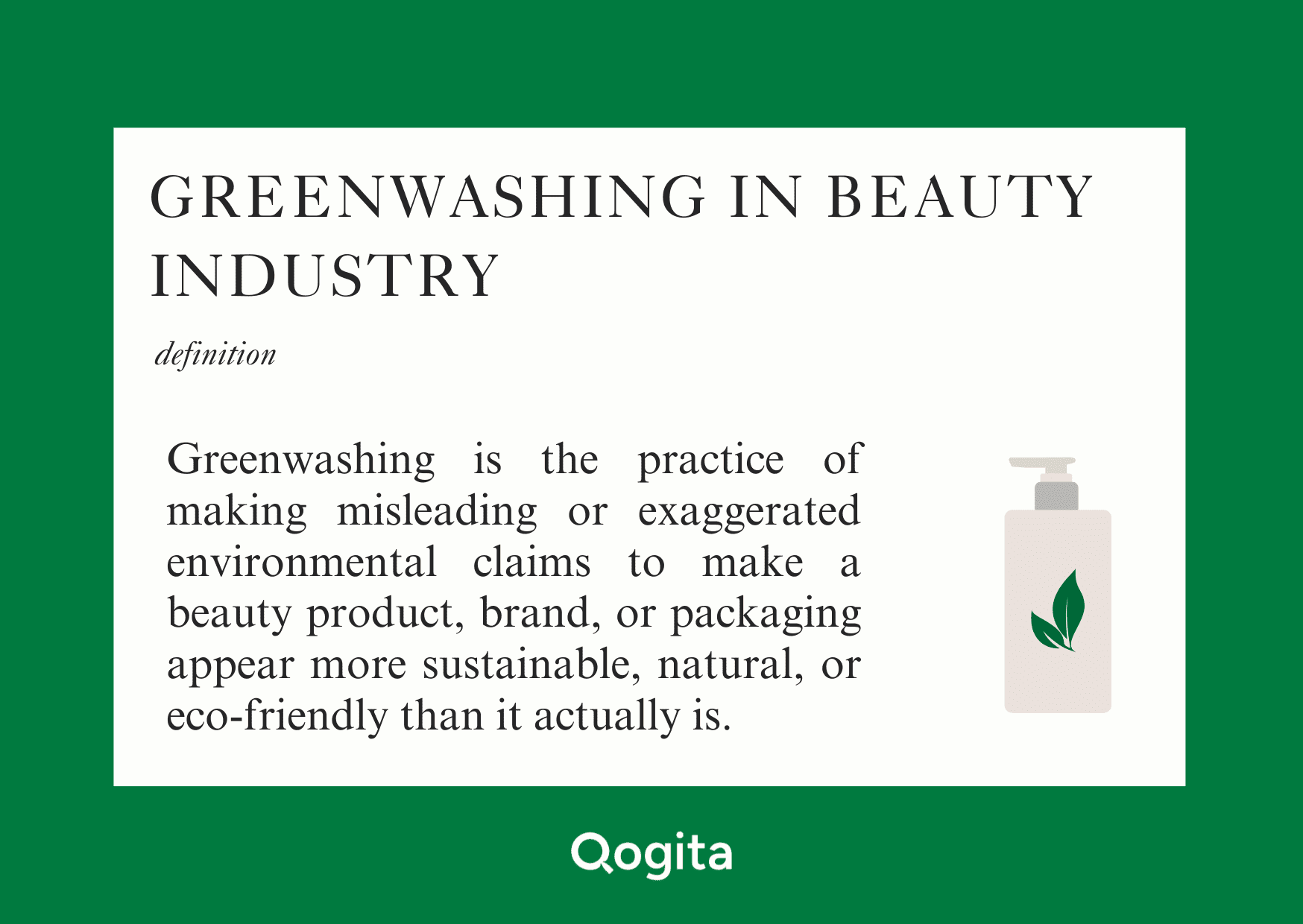
Enter greenwashing. According to the Oxford English Dictionary, greenwashing covers any activities a company undertakes to make people think it is concerned about the environment, even if its real business harms the environment.
That is exactly why we wrote this guide. Not for the brands, but for the retailers and customers who are looking for products that do what they claim to do. Once you know what to look for, spotting greenwashing becomes second nature.
What Exactly Is Greenwashing?
Let’s first understand the history of greenwashing. Who recognised the term first? And most importantly, in what context was it used?
Greenwashing was first coined by environmentalist Jay Westerveld back in 1986. In his essay, he called out hotels that encouraged guests to reuse their towels under the guise of environmental responsibility. In reality, it was simply a cost-cutting measure. Back then, before the advent of Google, it was much harder to fact-check. Brands could make almost any claim they liked and get away with it.
The phrase was recognised as an official term by the Oxford Dictionary in 1999, defined as "disinformation disseminated by an organisation so as to present an environmentally responsible public image." It has only recently entered mainstream vocabulary, beginning to be used widely in the early 90s following the Rio de Janeiro Earth Summit in 1992.
So, what does greenwashing mean?
At its core, greenwashing is the practice of pretending your product is organic, natural, or ethical when in fact it is not. It can happen accidentally, but that is not an excuse. Brands that engage in this practice spend far more money on pretending to be green than they ever do on actually trying to be sustainable.
Probably the largest and most prominent greenwashing example is the Volkswagen emissions scandal. In 2015, they sold cars with a software modification that detected when they were being tested and changed engine performance accordingly to improve environmental test results. Volkswagen admitted cheating emissions tests and had to recall over eleven million cars.
The sad reality is that in the beauty and skincare industry, it rarely makes headlines in quite the same way. But the good thing is that it’s now popular as customers are well-aware and educated about their rights. Social media platforms like TikTok and Instagram also play an active role in revealing the true nature of brands that scam customers in the name of “organic,” “clean,” and “natural” beauty products.
Why Beauty Industry Is Especially Vulnerable
The beauty industry has a greenwashing problem that runs deeper than most. The reason is simple. Unlike the food industry, where "organic" is a tightly regulated term, in beauty and skincare, it is almost entirely unregulated.
A beauty product only has to contain 1% organic ingredients to avoid being pulled up by the Advertising Standards Agency for calling itself organic. Every single other ingredient can be synthetic. "Natural" is even more loosely defined. There is no legal definition for it in cosmetics, and any brand can use the word freely, regardless of what their product actually contains.
Here’s a good example of how misleading this can get. A brand claims "95% natural ingredients" on the front of their packaging. But since water counts as a natural ingredient, a formula that is 70% water and 25% plant-derived glycerin could legitimately make that claim, while the remaining 5% includes harmful preservatives and fragrance compounds. So the percentage on the packaging tells you nothing. It’s a working greenwashing method for brands to scam customers.
Buzzwords That Sound Good But Mean Nothing
There are some buzzwords that appear on product packaging, in marketing copy, and are plastered across a brand’s social media to get public attention. Most of them mean nothing because they are not defined and regulated in the beauty industry.
"Natural": Has no legal definition in cosmetics. As we said before, a product can contain 95% synthetic ingredients and still be marketed as natural.
"Clean": Entirely undefined. Different brands use it to mean different things. There is no standard, no checklist, and no one checking.
"Pure": No regulatory meaning in cosmetics. Often used to suggest a product is free from unwanted additives, but there is no requirement to back that claim.
"Green," "eco-friendly," "sustainable": A brand can print a leaf on its packaging without any obligation to demonstrate environmental responsibility whatsoever.
"Botanical": Means the product contains at least one plant-derived ingredient. It says nothing about the concentration of that ingredient or what else the product contains.
"Chemical-free": Technically makes no sense at all. Any compound or substance is a chemical. Even water is a chemical. If you spot this on a label, treat it as a red flag.
"Dermatologist tested": Means a dermatologist was paid to test the product. It does not mean the product was approved or recommended. The results are not required to be disclosed.
The pattern here is consistent. All these are marketing terms, not regulated standards. They tell you what a brand wants you to think, not what the product actually contains. That’s exactly what greenwashing is.
However, not every sustainability claim is misleading. There are plenty of eco-friendly beauty brands that back up their environmental commitments with real action and transparency.
How Brands Greenwash: The Tactics
Beyond vague language, these are some specific tactics that greenwashing brands use repeatedly:
Making claims they cannot back up.
Sustainability claims with no certifications, no data, and no third-party verification like PETA behind them. Any brand can say it is committed to the planet. What matters is the proof. How are they committed? Do they have any certificates? Any evidence to back claims?
The hero ingredient illusion.
A product is marketed around a single appealing ingredient, such as rosehip oil, vitamin C, bakuchiol, that appears prominently in the marketing copy but is buried near the bottom of the ingredient list. The concentration is usually too low to have any meaningful effect, but it justifies the natural or active claims on the front of the packaging.
The "free from" list.
Packaging that leads with what a product does not contain, paraben-free, sulfate-free, silicone-free, without disclosing what it actually does contain. A product can be free from all of these things and still be primarily synthetic. If brands are not using “free from,” they’re probably using the “zero” list (zero preservatives, zero sulfates, etc).
Misleading percentages.
Claims like "99% natural ingredients" that sound impressive until you understand how the calculation works. Water counts as a natural ingredient. So does plant-derived glycerin. The percentage alone does not tell the full story.
Green packaging that means absolutely nothing.
Recyclable packaging, green colour schemes, and a picture of leaves on the front of a product that contains synthetic ingredients. Sustainable packaging and sustainable formulation are two very different things. One does not imply the other.
Carbon offsetting as a cover.
Some brands make a lot of noise about donating to carbon offset schemes while sharing no information about their actual manufacturing, packaging, or recycling practices. Offsetting does not cancel out harm. Many carbon offsetting projects do not even achieve the figures they claim.
Very low product prices.
Truly organic and natural production costs more than mass production. If a product is remarkably cheap, it is worth asking why. Super cheap products will almost always raise suspicion.
How to Spot Greenwashing: The Prevention Guide
The good news is that greenwashing is identifiable once you know what to look for. Here is how to evaluate a brand properly before you decide to stock its products.
Read the ingredient list, not the packaging.
The ingredient list, the INCI list, is where the truth lives. Ingredients are listed in descending order of concentration. This means whatever appears first makes up the largest part of the formula. If the first ingredient is water, followed by several synthetic compounds, and the botanical ingredient the brand is marketing around appears tenth or lower on the list, the product is mostly synthetic. It does not matter what the front of the packaging says.
A few things to look for specifically:
- Ingredients ending in "cone" or "siloxane" indicate silicones.
- PEG compounds indicate a synthetic petrochemical origin.
- "Parfum" or "fragrance" represents a blend of undisclosed chemicals.
- Parabens, sulfates, and phthalates are signs that the product is not genuinely natural, despite any claims to the contrary.
Look for third-party certifications.
While beauty brands may freely use buzzwords, there are some claims that are standardised and certified by independent third-party organizations. These are the ones that carry real accountability. Look for certification logos on packaging and cross-reference them on the certifying body's website. We’ll tell you exactly which certificate to look for in the next section.
Do your research on the brand.
Look beyond the product itself. Does the brand share transparent sustainability standards on its website? Do they talk openly about their manufacturing process, ingredient sourcing, and packaging? Brands that are genuinely doing the work are usually more than happy to talk about it.
Also, see if anyone is calling out the brand for making false claims online. Some social media pages and channels, like DW Planet A on YouTube, make videos about companies that hide their true intentions. Be sure to check them out.
Be wary of in-house certifications.
Some companies create their own stamps and seals that look official but are entirely self-certified. These are not equivalent to independent third-party certifications. If you cannot find the certifying organization with a quick search, it is likely not a real one.
Certifications That Actually Mean Something
All these certifications require independent verification and adherence to documented standards, which is why they’re one of the best ways to spot greenwashing. It’s very important to look for these on the product packaging or on the company’s website. You’ll likely find these certificates on the package if the company is legitimate.
Quick Red Flag Checklist To Spot Greenwashing
Before you decide to buy a beauty or skincare brand, run through these questions to spot greenwashing. Obviously, the more red flags you see, the more cautious you should be.
On the packaging and marketing:
- Does the brand heavily use words like "natural," "clean," "pure," or "eco-friendly" with no certifications to back them up?
- Is the packaging covered in green colours, leaf images, and nature references, but with no mention of recyclability?
- Does the brand make a big deal about what the product does not contain, without telling you what it actually does contain?
- Are there any official-looking certifications, seals, or stamps that you cannot verify with a quick search?
On the ingredient list:
- Do the first five ingredients include synthetic compounds, with the hero natural ingredient buried near the bottom of the list?
- Does the list include "parfum" or "fragrance" with no further disclosure?
- Are there ingredients ending in "cone" or "siloxane," PEG compounds, or mineral oil present despite natural claims?
- What is the percentage of natural ingredients like water, glycerine, etc?
On the brand itself:
- Does the brand make sustainability claims with no data, no certifications, and no third-party verification?
- Do they talk about carbon offsetting but share nothing about their actual manufacturing or packaging practices?
- Are their sustainability commitments true?
- Is the product very cheap for something claiming to be genuinely organic or natural?
- Is it difficult to find clear information about where their ingredients come from?
If a brand passes this greenwashing checklist cleanly, that is a good sign. If several of these flags come up at once, you need to dig deep before committing to their products.
Conclusion
Greenwashing is not going away. If anything, as consumer demand for sustainable beauty grows, the tactics will get even more sophisticated. But as a retailer, you are in a position to spot greenwashing and make a real difference here.
Stock the brands that can back up what they claim. Ask the hard questions. Check the certifications we listed above. The brands genuinely doing the right thing will always have the answers ready. And the ones that can’t answer? Well, they’re likely involved in greenwashing.
If you’re a retailer, make sure to read: